|

|
|
Home Base:
Suger Grove, IL
Operation: Central and Eastern USA
Model: SNJ-5
Wing Span: 42' 0"
Length: 29' 6"
Height: 11' 9"
Max Speed: 240 mph
Gross Weight: 5,300 lbs
Power Plant: Pratt & Whitney R1340-AN-1
Horsepower: 600
Fuel Capacity: 110 gallons
Armament: none |
Gauntlet Warbirds
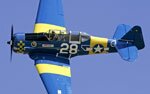
North American SNJ-5 Texan

Gauntlet Warbirds is the owner and operator of
this North American SNJ-5 Texan, which is
available for airshows, flybys,
training, rides and film. Gauntlet Warbirds is a
warbird, aerobatic and tailwheel training center at the
Aurora Airport, just west of downtown Chicago. Their
instructors specialize in transitioning pilots of all
experience levels to high-performance piston and jet
aircraft.
One of the most recognized aircraft series of all
time, the ruggedly handsome Texan family of advanced
training and multi-purpose designs all share a common
ancestor: the NA-16 of 1935. Developed to compete in an
Army Air Corps competition for the Basic Trainer
specification, the first production variants received
the designation BT-9. As the lineage evolved, the
designations progressed through BT-9A, BT-9B, BT-9C,
Y1BT-10, BT-14, BC-1 and BC-1A (for Basic Combat, a
relatively short-lived category of trainer), all for the
Air Corps, and finally the NJ-1 and SNJ-1 for the U.S.
Navy. Most of these variants had fixed (non-retractable)
landing gear but, starting with the Air Corp BC-2, the
definitive shape of the aircraft, which has become so
familiar worldwide, emerged. The United States Army Air
Corps (later the U.S. Army Air Forces), Air Force, Navy,
Marine Corps, Coast Guard and an incredible array of
foreign export purchasers saw the emergence of an
alphabet of type designations through subsequent
refinements. Although differing only in equipment, they
all appeared to the observer to have the same classic
lines, even though the development ranged from AT-6,
AT-6A, AT-6B, AT-6D, XAT-6E, AT-6F, and T-6G for the
USAAF and USAF. The utilized the SNJ-2, SNJ-3, SNJ-4,
SNJ-5, SNJ-6, SNJ-7, and SNJ-8 variations. In British
Commonwealth nations, the designation was Harvard. In
the United States, it bore the official nickname of
Texan.
By the end of World War Two, almost every Allied
nation with an air arm employed some variant of the
NA-16, AT-6, SNJ or Harvard. Although characterized as
an advanced trainer by most, the aircraft could mount
both machine guns and light bombs. In at least one
instance, an Australian variant, known as the Wirraway,
demonstrated that it could reasonably emulate a
fighter,
when it successfully engaged a Japanese Navy Mitsubishi
A6M Zero in air combat. The
type became essential to
military aviation in Latin America, where its
versatility was legendary. After the end of World War
Two, arguably more pilots trained on Texan variants than
any other single series type. The Texan soldiered on
post-war, seeing action during the Korean Conflict and
contributing to the evolution of the Forward Air
Controller concept. North American remanufactured
hundreds of Texans into the T-6G configuration to meet
post-war Air Force and foreign operator requirements. In
some nations, Texans and Harvards remained in service
until the 1980s, making it one of the longest-lived
aircraft designs in aviation history. Today, T-6s are by
far the most common warbird type seen at air shows
worldwide, and have prompted the creation of a dedicated
interest group - the North American Trainer Association
(NATA).
Aviation cadets honed many of the skills required for
combat on the Texan, including instrument flying,
formation flying, navigation, radio communication,
gunnery, and operation of an aircraft with "complex"
features such as variable pitch propellers, retractable
landing gear, and flaps. By the time most students began
training on the Texan, they had already passed the
"weed-out" stage of primary flight training. Students
would usually have already acquired 80-100 hours of
flight time on primary trainers such as the Army Air
Force PT-13 or the Navy N3N and N2S (see NASM collection
for both).
In 1943, a batch extending from BuAer 51350 to 51676
rolled off the assembly line at the North American
Aviation factory near Dallas, Texas. It was unusual in
having all-wood stabilizers and rear fuselages. In 1942,
fears of wartime shortages of strategic metals such as
aluminum dictated this construction. Only certain AT-6Cs
and SNJ-4 variants shared this feature.
It spite of its intensive use (or abuse) at the hands
of hundreds of cadet pilots, the aircraft suffered only
relatively minor accidents throughout its service life,
although the logbooks record numerous scrapes and
scratches. Other than the service modifications
prescribed during its service life, it remains a stock
example in almost every respect, and an ideal
representative of "the pilot maker" series that served
the Allied cause so well.
Gauntlet Warbirds’ SNJ-5 was delivered to the Navy in
1944. A tremendously versatile aircraft, the SNJ can be
easily looped from cruise flight and is an outstanding
platform for formation flying. A total of 20,110 Harvards/T-6s/SNJs
were built between 1938 and 1954, 3,370 of them in
Canada.
Gauntlet Warbirds offers rides in their SNJ-5/T-6 a
to allow pilots and non-pilots alike to experience
flying a World War II warbird aircraft. No pilot's
license or flying experience is required. Our
instructors will work with you to design your ideal
flight profile. The flight can be as wild or mild as you
like; let us fly or take the controls yourself.
The entire experience lasts about two hours. It
starts with meeting your instructor pilot (IP) to
discuss your ideal flight profile. Our IPs are all
experts whose mission is ensuring that you have an
enjoyable experience. You will start with some basic
warmup maneuvers and then progress into basic and
advanced aerobatics. If you choose to fly the aircraft
yourself your IP will demo a maneuver and then talk you
through it as you try it. The flight ends with a
military style overhead break approach and landing back
at ARR. Following the flight you can take pictures of
yourself and your IP with the aircraft, and if a video
option was selected for the flight you will receive the
video on a USB drive to take home and share with friends
and family.
The SNJ-5/T-6 transition course prepares pilots of
all experience levels to act as PIC of the SNJ-5/T-6 or
any of its many variants. The course covers normal and
emergency procedures, stalls, spin entries, three point
landings, wheel landings, crosswind operations, overhead
approaches, unusual attitude recoveries and basic
aerobatics.
The length of the course varies depending on pilot
experience but generally ranges from five to fifteen
hours. Students beginning the course should have a
tailwheel endorsement. If they do not, one will be
completed in the Decathlon prior to beginning training
in the SNJ-5/T-6. Contact one of our staff members to
discuss your background and we will be able to provide a
more precise estimate.
Photo
Gallery
Contact
|
Gauntlet Warbirds
43W624 US 30
Sugar Grove, IL 60554
Phone: (630) 999-2044 |
 |
|
Please fill out your contact information
below if you are interested in contacting
the operator, or agent,
of this Warbird and you require more information for booking this
aircraft at your Airshow
or Event. |
|