|

|
|
Home Base:
Montgomery County, NC
Operation: Central and Eastern
USA
Model: AT-11
Wing Span: 47' 8"
Length: 34' 2"
Height: 9' 8"
Max Speed: 225 mph
Gross Weight: 7,800 lbs
Power Plant: 2 x Pratt & Whitney
R985AN-14 "Wasp Jr.", 9 cylinders
Horsepower: 2 x 450
Fuel Capacity: 207 gallons
Armament: 10 x 100 lb bombs, 2 x.30
caliber machine guns.
|
Mike
and Preston Allen's
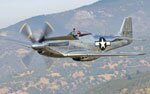
Beechcraft AT-11

Mike and Preston Allen are the owners and operators of this
1942 Beechcraft AT-11 (S/N 44-72015), which is
available for airshows,
flybys and film.
This is the sole survivor of the 24 AT-11's purchased
by the Royal Netherlands Navy in 1941 for use as a light
bomber in Java, Dutch East Indies (Java). The Japanese
took the Dutch East Indies before the aircraft could be
delivered. In May of 1942 the Royal Netherlands Military
Flying School was established in Jackson, Miss. to train
escaped Dutch to become pilots, bombardiers, and
gunners. Of the 24 AT-11's used there, this is the only
one left in existence! It still retains its original
non-feathering propellers and 33 inch main tires. It was
also used by the Raspet Flight Research Laboratory at
Mississippi State University.(1956-1980).
The AT-11 was the standard U.S. Army Air Forces World
War II bombing trainer; about 90 percent of the more
than 45,000 USAAF bombardiers trained in AT-11s. Like
the C-45 transport and the AT-7 navigation trainer, the
Kansan was a military version of the Beechcraft Model 18
commercial transport. Modifications included a
transparent nose, a bomb bay, internal bomb racks and
provisions for flexible guns for gunnery training.
Student bombardiers normally dropped 100-pound
sand-filled practice bombs. In 1943 the USAAF
established a minimum proficiency standard of 22 percent
hits on target for trainees. Typical combat training
missions took continuous evasive action within a 10-mile
radius of the target with straight and level final
target approaches that lasted no longer than 60 seconds.
After Sept. 30, 1943, the AT-11 usually carried a Norden
Bombsight and a C-1 automatic pilot, which allowed the
bombardier student to guide the aircraft during the
bombing run.
In the gunnery training mode either a single 30
caliber motor driven turret (Made by Beechcraft and used
on early AT-11's) or a twin 30 caliber electrically
powered turret (made by Crocker
Wheeler and used on later AT-11's and all SNB-1's) was
installed in the top of the rear fuselage.
There was
also a tunnel gun which consisted of a flexible mounted
30 caliber machine gun in the lower rear fuselage. Two
student gunners would man the turret and the tunnel gun
as an instructor watched over them.
The AT-11 was set up just like a miniature version of
the B-17 Flying Fortress or the B-24 Liberator. The
advanced trainer was supposed to simulate the same
environment as the full sized bombers. Tied into the
Norden bombsight was the same C-1 autopilot that was
used on all of the bombers of WWII. It was through this
autopilot that the Bombardier could fly the aircraft
through the bombsight.
A Navigator's position was located in the right rear
fuselage (in the AT-11 only) which allowed for crew
coordination training between the Pilot, the Bombardier,
the Gunner and the Navigator. 192 AT-11's were
configured with the Navigators station at the factory.
Beech also made a Navigators station kit so aircraft in
the field could be modified should the operating
authority choose to do so. Most all of the AT-11's that
I have seen show signs of this modification either from
the factory or the field mod. The AT-11 was equipped
with an oxygen system to allow for high altitude
missions. The AT-11 and the SNB-1 had an SCR-283 radio
set for communication between the tower and other
aircraft.
The Beechcraft AT-11 was so successful that it was
used by many other Air Forces during WWII including the
Royal Netherlands Air Force and the Brazilian Air Force.
The Chinese Air Force reportedly used the AT-11 in
combat.
Photo
Gallery
Contact
|
|
|
|
Please fill out your contact information
below if you are interested in contacting
the operator, or representative,
of this Warbird and you require more information for booking this
aircraft at your Airshow
or Event.
|
|


![[Warbird Depot Home Page]](/images/header_2a.jpg)