[Warbird Depot Home Page]


Home Base: San Antonio, TX
Operation: Western and Central USA
Model: L-2M
Wing Span:
35' 5"
Length: 22' 9"
Height: 8' 0"
Max Speed: 92 mph
Gross Weight: 1,325 lbs
Power Plant: Continental O-170-3
Horsepower: 85
Fuel Capacity: 12 gallons
Armament: none

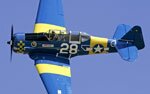
Alamo Liaison Squadron's Taylorcraft L-2M "Whispering Hope"


The Alamo Liaison Squadron is the owner and operator
of this beautifully restored Taylorcraft
L-2M "Whispering Hope" (43-26173) which is available for airshows, flybys and film.

The Taylorcraft L-2 (L for Liaison) Grasshopper is an observation and liaison aircraft used by the United States Army Air Forces in World War II. The L-2, adapted from Taylorcraft's pre-war commercial Model Tandem Trainer, was initially designated the O-57 at the time it was first ordered by the Air Corps.

Following an aerial observation tradition more than 200 years old, the Taylorcraft Model D tandem trainer was "drafted" in 1941 for artillery spotting, light transport and courier service. After the U.S. Army successfully evaluated examples of the aircraft under the designation YO-57 for use in artillery spotting and liaison, 70 were ordered as the O-57 Grasshopper, powered by a 65hp Continental O-170-3 engine. That order was followed by a modification that added a radio and improved the all-around view with additional glazing to the cockpit area. 336 of that variant, designated O-57A, were ordered.

When American troops went into combat in WWII, the Army Air Force used the O-57/-57A for directing artillery fire on enemy troop and materiel concentrations, much as observation balloons had been used in WWI. The O-57, being far more mobile than earlier hot air and gas balloons, was also used for other types of liaison and transport duties, its ability to land and takeoff from small unprepared landing strips making it an ideal front-line vehicle.

140 of the O-57As were ordered in 1942, at which time the two variants were re-designated L-2 and L-2A, respectively.

Subsequent modifications yielded 490 L-2Bs aircraft produced especially for field artillery spotting and a variant with wing spoilers and a completely cowled engine, the L-2M, of which 900 were ordered. Various civilian models of Taylorcraft, in small quantities, were "drafted" into military service with designations from L-2C through L-2L.

253 engineless gliders based on the L-2 design were also manufactured by Taylorcraft for use as glider trainers. Designated ST-100, they were used primarily by the U. S. Army to train glider pilots for combat insertions, often behind enemy lines (as, for example, in the Normandy landings).

While some L-2s were furnished to foreign air forces, many were "mustered out," to rejoin their civilian counterparts on the U.S. civilian register after the war as comparatively cheap "warbirds." In the immediate postwar era, the commercial BC-12 D was manufactured for a time, and has become a popular example of late-1940's light aircraft.

This Taylorcraft L-2M was build in 1943 for the United States Army Air Forces. It, along with many other liaison aircraft served our country in many different capacities, including artillery spotting, communications, training, medical evacuation, supplies, and other general transportation uses.

While the observation tradition today is more likely to be carried on by pilotless aircraft, or the even more exotic "Micro Air Vehicles" being experimented with in numerous high-tech research facilities, the various species of "Grasshoppers" used by the United States in WWII will always occupy a special niche in the lore of aviation.

Photo Gallery

Contact

Alamo Liaison Squadron
2352 S. Loop 1604 W.
San Antonio, Texas 78264

Phone: (210) 624-2226


Please fill out your contact information below if you are interested in contacting the operator, or agent,
of this Warbird and you require more information for booking this aircraft at your Airshow or Event.


Name:

Phone Number:

Email Address:


Copyright © 2010 Warbird Depot.  All Rights Reserved  |  Privacy Policy  |  Terms of Use