[Warbird Depot Home Page]


Home Base: Burr Ridge, IL
Operation: Central and Eastern USA
Model: P-51D-25-NA
Wing Span:
37' 0"
Length: 32' 2"
Height: 13' 8"
Max Speed: 505 mph
Gross Weight: 10,500 lbs
Power Plant: Rolls-Royce Merlin V-1650-7
Horsepower: 1,490
Fuel Capacity: 184 gallons
Armament: 6 x .50 caliber machine guns

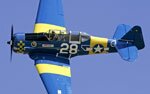
Vlado Lenoch's N.A. P-51D Mustang "Moonbeam McSwine"


Vlado Lenoch is the owner and operator of this beautiful North American P-51D Mustang "Moonbeam McSwine", which is available for airshows, flybys and film. "Moonbeam McSwine" is also available for a 10-15 minute warbird aerobatic airshow and is a member of the extremely popular United States Air Force Heritage Flight program.

The P-51 was designed and built by North American Aviation after the British government approached them to build P-40 Warhawks under license. North American believed they could design a better fighter, and the British government gave them 120 days to prove it. 102 days after the order was placed, the first Mustang was completed, flying for the first time on October 26, 1940. The prototype and subsequent P-51A utilized the Allison V-1710 liquid cooled engine. Lacking an effective engine supercharger, the Allison provided insufficient power for the high-altitude environment the P-51 was designed to operate in. By replacing the Allison engine with a Rolls-Royce V-1650 Merlin engine that had a two-stage supercharger, the necessary power and performance was gained. The Merlin engine, which was built in the U.S. under license by the Packard Motor Car Company, was installed in all further P-51 models from the “B” through the “H” versions.

The P-51 was the United States supreme air-superiority fighter in the European Theatre of Operations (ETO) during WWII. It served as a fighter-interceptor, Bomber-escort and fighter-bomber. With the powerful Merlin engine and droppable fuel tanks, the Mustang was able to penetrate deep into German territory where no previous Allied fighter had been able to go. The P-51 could escort bombers to all but the deepest targets inside Germany. With a fighter escort, fewer bombers were lost to the Luftwaffe’s fighters. Reichmarschall Hermann Goering, Supreme Commander of the Luftwaffe said “ When I saw Mustangs over Berlin. I knew the war was lost.”

The P-51 was considered by many to be the finest fighter that the U.S. produced and flew in WWII accounted for almost half the enemy aircraft destroyed in Europe by U.S. fighters. The Mustang was equipped with six .50 caliber machine guns and incorporated the advanced K-14 lead computing gun sight. The unmistakable scoop on the underside of the Mustang is the air inlet for the coolant radiator and oil cooler.

A combined total of over 15,500 Mustangs were produced. The greatest number of Mustangs were built as the “D” model, with over 8,000 built. Today less than 150 Mustangs remain flyable or restorable to flying condition.

Vlado’s P-51 Mustang is restored in the markings of Captain William T. Whisner who joined the 487th Fighter Squadron, 352nd Fighter Group in the fall of 1943, known as "The Blue-nosed Bastards of Bodney", which was based in Bodney, England. On January 29, 1944, while flying a P-47 Thunderbolt, serial number 42-8404 (HO-W), he scored his first air-to-air victory against a Focke-Wulf Fw-190. When the 352nd Fighter Group transitioned to the P-51 Mustang in April 1944, Whisner flew "Princess Elizabeth", s/n 42-106449 (HO-W), a P-51B. On May 29th, he scored his third air-to-air victory, and the next day shared a victory with George Preddy. Shortly thereafter, he was sent back to the United States on leave.

Whisner, now a captain, returned to the 352nd in the fall of 1944, and began flying a P-51D Mustang, s/n 44-14237 (HO-W), which he called "Moonbeam McSwine". On November 21, 1944, the setting for the painting "Full House, Aces High", Whisner became an ace in a day, shooting down six Fw-190s. For this accomplishment, he was awarded the Distinguished Service Cross, second only to the Congressional Medal of Honor.

During the Battle of the Bulge in December 1944, the 487th was moved from Bodney to airfield Y-29 near Asche, Belgium. On January 1, 1945, twelve P-51 Mustangs, led by Lt. Col. John Meyer, began their takeoff roll when the airfield was attacked by an estimated 50 German Luftwaffe Bf-109s and Fw-190s. Whisner shot down an Fw-190, then, his plane was hit by 20-mm fire. With one of his ailerons damaged and his canopy covered with oil, he continued the fight, shooting down two more Fw-190s and one Bf-109. Whisner was awarded his second Distinguished Service Cross and the 487th received the Distinguished Unit Citation, the only fighter squadron in the 8th Air Force be so honored. Whisner finished the war with 15.5 air and 3 ground victories, and flew 137 combat missions.

During the Korean War, Whisner flew the F-86 Sabre with the 4th and 15th Fighter Interceptor Wing, shot down five MiG-15s, and was awarded his third Distinguished Service Cross, the only Air Force man other than General John Meyer to earn that distinction. He was the only Air Force pilot to be an "ace" in two wars and a three-time winner of the Distinguished Service Cross.

Photo Gallery


Contact

Please fill out your contact information below if you are interested in contacting the operator, or agent,
of this Warbird and you require more information for booking this aircraft at your Airshow or Event.


Name:

Phone Number:

Email Address:


Copyright © 2008 Warbird Depot.  All Rights Reserved  |  Privacy Policy  |  Terms of Use