|
|
|
Home Base:
San Antonio, TX
Operation: Western, Central and Eastern
USA
Model: P-38F
Wing Span: 52' 0"
Length: 37' 10"
Height: 12' 10"
Max Speed: 420 mph
Gross Weight: 20,300 lbs
Power Plant: 2 x Allison
V-1710-89/91
Horsepower: 2 x 1,425
Fuel Capacity: 410 gallons
Armament: One 20 mm. Hispano AN-M2C
cannon and four .50 caliber Browning machine
guns. External bomb load of 4,000 lbs. or ten 5
in. rockets.
|
Lewis
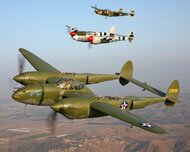
Air Legends Lockheed P-38F Lightning "Glacier Girl"

Lewis Air Legends, of San Antonio, Texas, is the owner of
this famous, and extremely rare, Lockheed
P-38F Lightning "Glacier Girl", which is available for airshows, flybys, film
and is also a member of the extremely popular United
States Air Force Heritage Flight program.
Easily one of the most recognizable fighters of its
time because of its distinctive twin-boom design, the
Lockheed P-38 Lightning was one of the most famous
American warplanes of World War Two and the mount of
America's two top acesDick Bong, who scored 40 aerial
victories, and Tommy McGuire, who was credited with 38
kills. However, although more than 10,000 Lightnings
were built during the war, the big fighter did not fit
into the Air Corps' post-war plans and was soon retired
from service.
At an empty weight of 12,7801b, a standard Lightning
is about twice the weight of contemporary single-engined
Allison-powered fighters such as the Curtiss P-40
Warhawk. It has twice the number of engines, coolant
systems, hydraulic and electrical lines.
In 1942, Glacier Girl was a brand new Lockheed P-38F,
one of hundreds of airplanes sent as part of Operation
Bolero to counter theGerman U-boat threat in the
Atlantic. Instead of sending warplanes by ship, the U.S.
Army Air Force had its pilots base-hop across the North
Atlantic from Maine to Scotland. Not all squadrons made
it across, and this particular one was forced down by
weather to an emergency landing on an ice cap in
Greenland. For Glacier Girl, that was leg one.
Lieutenant Harry L. Smith had a 23-year-olds knack
for popular expressions and a military pilots level
head. Before attempting to land his P-38 on a forlorn
stretch of the Greenland ice cap, he flew over another
pilots Lightning, which had just slammed over on its
back in the slushy summer snow. Smith was searching
hopefully for some sign of life in the upside-down
aircraft. "Susie-Q, its happened! Its true!" Smith
rhymed in a journal written shortly after the July 15,
1942 crash landing of six P-38s and two B-17s. "The lad
is climbing out, hes waving at
me. Old Mac! I pull er up in a roll over him, and
circle to approach".
Smith throttled back at 200 feet, cut off the fuel,
feathered the props, and slid, wheels up, into a snowy
landing. Before sprinting off to join his downed
buddies, he logged in details of the light and landing,
shrugged off his parachute, removed his helmet, and
threw the keys to the P-38s canopy inside the cockpit.
After decades of snowstorms, Glacier Girl had been
buried 268 feet deep. Crews used streams of hot water to
melt a 48-inch-wide tunnel down to the plane and open a
cavern around it.
Disassembling and retrieving the plane took about
four months and cost about $638,000, said Bob Cardin,
director of the restoration effort. Tooling parts to
replace those destroyed by the weight of the ice has
pushed the cost to the $3 million range, Shoffner said.
Restoration of Glacier Girl began in January of 1993,
after all shipments of aircraft parts from the dig were
finally gathered together. The restoration was being
done in Roy Shoffner's (project financier) hangar in
Middlesboro, Kentucky. Under supervision of Bob Cardin
(project coordinator for the 1992 expedition) warbird
specialists began their task by disassembling the
massive center section. After initial deconstruction of
the plane began, it was evident that damage was more
extensive than what appeared on the surface. The more
they took apart, the more damage they found. The plane
had to be taken apart down to the smallest manageable
pieces, making sure each piece was marked for later
identification. Parts were then cleaned and checked for
functionality to determine if it could be used again,
repaired for use, or replaced entirely. Damaged parts
served as templates for construction of replacements.
Aiding in the process of restoration, an extensive
research library was compiled. For research and copy
fees of $1,200, the Smithsonian Institution supplied
eight reels of microfilm and stacks of photocopies of
era aviation maintenance handbooks, parts and repair
manuals. Cardin's team, using the acquired documents,
managed to more or less duplicate the original
construction process carried out in the 1940s.
Spring of 1993 saw the beginning of actually
rebuilding the plane, the main spar being the starting
point. Clicos -- temporary fasteners resembling bullets
-- were used so parts could be attached and removed to
ensure proper fit and to be certain no pieces were
overlooked.
Parts were much cheaper to acquire than creating
molds to fabricate new ones. Finding them proved to be
another adventure in itself. Cardin said he and Shoffner
had visited people who claimed to have P-38s, only to
discover unrecognizable piles of aluminum that wouldn't
pass as airplane parts. They felt like they spent more
hours playing detective than actually acquiring parts.
Even when parts were located, owners were reluctant to
part with them.
A 22-year slog through recovery and restoration could
not have been completed without the ingenuity, stamina,
and fortune of a whole squadron of people beguiled by
the P-38. During this period, the airplanes chief
benefactor, the late Roy Shoffner, a Kentucky
businessman, named the P-38 Glacier Girl.
When this project was completed, Glacier Girl was one
of the most perfect warbird restorations ever. "This is
going to be the finest P-38 in the world, and it may be
the finest restoration of any warbird ever done," said
Cardin.
Work completed, thousands of people, from veteran
aviators and aviation buffs to curious onlookers, came
to the hangar in Middlesboro, Kentucky, to see a
not-so-forgotten piece of history. With propellers
whirling and 1,275-horsepower twin engines humming,
pilot Steve Hinton raced the P-38 Lightning down the
runway and lifted it into a gray sky for a 30-minute
flight before an estimated 20,000 spectators in this
small eastern Kentucky town.
Today, there are probably fewer than a score of
intact Lightning airframes left in the world and only
about half a dozen of those are flyable or restorable to
flying condition. Glacier Girls new owner Rod Lewis,
bought the fighter in 2006.
Photo
Gallery
Contact
|
|
|
Please fill out your contact information
below if you are interested in contacting
the operator, or representative,
of this Warbird and you require more
information for booking this aircraft at
your Airshow or Event.
|
|


![[Warbird Depot Home Page]](/images/header_2a.jpg)